Back to Archive

LA-AI Insights: The Biological Hardware of Learning

Your weekly AI news and updates from Lower Alabama

Thursday, March 5, 2026

Share this newsletter:


While we often discuss how AI models “learn” through vast datasets and mathematical optimization, the process for our biological hardware is far more physical. Learning is essentially the act of re-wiring your brain through synaptic plasticity—a process where neurons strengthen their connections through repeated and effortful use. When you encounter a new concept, your hippocampus acts as a temporary loading dock, holding information before it is eventually consolidated into long-term storage in the cortex during sleep.

The challenge is that our brains are naturally designed to be efficient, which often means they are designed to forget anything that doesn’t seem vital. If we use AI to simply provide a summary or a quick answer, we are effectively bypassing the neural effort required to signal to our brain that this information is worth keeping. To truly learn in depth, we have to lean into the “friction” of understanding, using AI not as a shortcut, but as a sophisticated coach that forces us to do the mental heavy lifting.

Transforming Research into Deep Knowledge

One of the most practical ways to use modern AI for learning is to move away from passive reading and toward active synthesis. Tools like NotebookLM have changed the game by allowing you to upload a collection of dense research and transform it into a conversational “Audio Overview.” This isn’t just a summary; it’s a multimodal way to prime your brain. Listening to a high-fidelity, podcast-style discussion of your research allows you to grasp the “big picture” and the relationships between ideas before you ever sit down to read the details. This initial “audio map” makes your subsequent deep-dive far more effective because your brain already has a framework to attach the new information to.

Once you have that foundation, you can use a large language model to act as a Socratic tutor. Instead of asking for a definition, you can prompt the AI to quiz you on the fundamentals or to find the “holes” in your logic as you explain a concept back to it. This is a digital version of the Feynman Technique: if you can’t explain a concept simply to the AI, you don’t yet understand it. The AI can then provide targeted feedback, helping you refine your mental model in real-time and ensuring that you are actually retrieving information from your own memory rather than just recognizing it on a page.

Designing for Long-Term Mastery

True expertise also requires us to manage the “software” of how we learn—specifically through patterns like spaced repetition and interleaving. Spaced repetition is the practice of revisiting a concept just as you are beginning to forget it, which signals to the brain that the information is critical for the long term. You can use AI to manage this logistics for you by asking it to generate a personalized study schedule or a set of practice scenarios based on your research that are designed to be reviewed over days and weeks rather than hours. This prevents the “illusion of competence” that comes from cramming, where information feels familiar but isn’t actually stored.

Interleaving is equally important and involves mixing different topics or types of problems within a single session. While it feels slower and more frustrating than focusing on one thing at a time, it forces your brain to discriminate between related concepts, which is how you build a durable cognitive foundation. By asking an AI to create a practice quiz that blends questions from two unrelated projects you are working on, you are training your brain to recognize when and why to apply certain pieces of knowledge. This turns a simple AI tool into a powerful engine for genuine mastery, moving you past the surface-level answer and into deep, permanent understanding


Upcoming Events

Join us this Friday for the Fairhope LA-AI Meetup!

Invalid Date

314 Magnolia Ave., Fairhope, AL

This Week in AI

1. Google Drops Gemini 3.1 Flash-Lite: A Cost-efficient Powerhouse with Adjustable Thinking Levels Designed for High-Scale Production AI

Google's Gemini 3.1 Flash-Lite introduces adjustable reasoning capabilities that allow developers to customize computational intensity based on task complexity, representing a significant advancement in production AI efficiency. This cost-optimized model enables enterprises to scale AI deployment while maintaining quality control over reasoning depth. The adjustable thinking levels feature addresses the critical challenge of balancing performance with computational costs in enterprise environments, potentially reshaping how organizations implement AI across different use cases and budget constraints.

MarkTechPostRead more

2. OpenAI changes deal with US military after backlash

OpenAI has modified its military partnership terms following public criticism, representing a significant pivot in AI company defense relationships. This development occurs as Anthropic withdraws from Pentagon discussions, leaving OpenAI to fill the void in government AI services. The deal restructuring signals evolving corporate ethics policies around military AI applications and demonstrates how public pressure influences strategic AI partnerships. This shift establishes new precedents for AI company engagement with defense agencies, potentially affecting future procurement and development of military AI systems across the industry.

BBC NewsRead more

3. Anthropic upgrades Claude’s memory to attract AI switchers

Anthropic has enhanced Claude's memory capabilities specifically to facilitate user migration from competing AI platforms, representing aggressive competitive positioning in the enterprise AI market. The upgrade includes advanced conversation history and context retention features designed to reduce switching friction for users leaving ChatGPT or other services. This strategic move indicates intensifying competition for AI market share, with companies focusing on user acquisition through migration-friendly features. The memory improvements suggest Anthropic is targeting enterprise users seeking more sophisticated contextual AI interactions, potentially reshaping competitive dynamics in the commercial AI services sector.

The VergeRead more

4. Alibaba Releases OpenSandbox to Provide Software Developers with a Unified, Secure, and Scalable API for Autonomous AI Agent Execution

Alibaba has launched OpenSandbox, a unified API platform for secure autonomous AI agent execution, addressing critical infrastructure gaps in AI agent deployment. The platform provides scalable security frameworks for AI agents, potentially accelerating enterprise adoption of autonomous AI systems across multiple industries. This infrastructure release signals growing maturity in AI agent ecosystems and establishes new standards for secure AI agent deployment. OpenSandbox's unified approach could influence how organizations implement AI agents, while its open architecture may drive broader adoption of autonomous AI systems in production environments.

MarkTechPostRead more

5. AI-generated art can’t be copyrighted after Supreme Court declines to review the rule

The Supreme Court's decision to decline review of AI art copyright restrictions establishes definitive legal precedent that AI-generated content cannot receive copyright protection, fundamentally altering the commercial landscape for AI applications. This ruling creates significant implications for business models built on AI-generated content, potentially limiting monetization opportunities while simultaneously expanding fair use possibilities for AI-created works. The decision provides crucial clarity for enterprises developing AI content generation strategies, requiring immediate reassessment of intellectual property strategies and revenue models across creative industries leveraging generative AI technologies.

The VergeRead more

6. Trump orders government to stop using Anthropic in battle over AI use

The Trump administration has issued an unprecedented government-wide ban on Anthropic's Claude AI system, marking the first major political targeting of a specific AI company. This executive action follows collapsed Pentagon negotiations and represents a significant escalation in AI governance, potentially fragmenting the market along political lines. The decision creates immediate strategic implications for enterprise AI adoption, government contractors, and establishes a precedent for political interference in AI partnerships that could reshape industry dynamics and international competitiveness.

BBC NewsRead more

Community Highlights

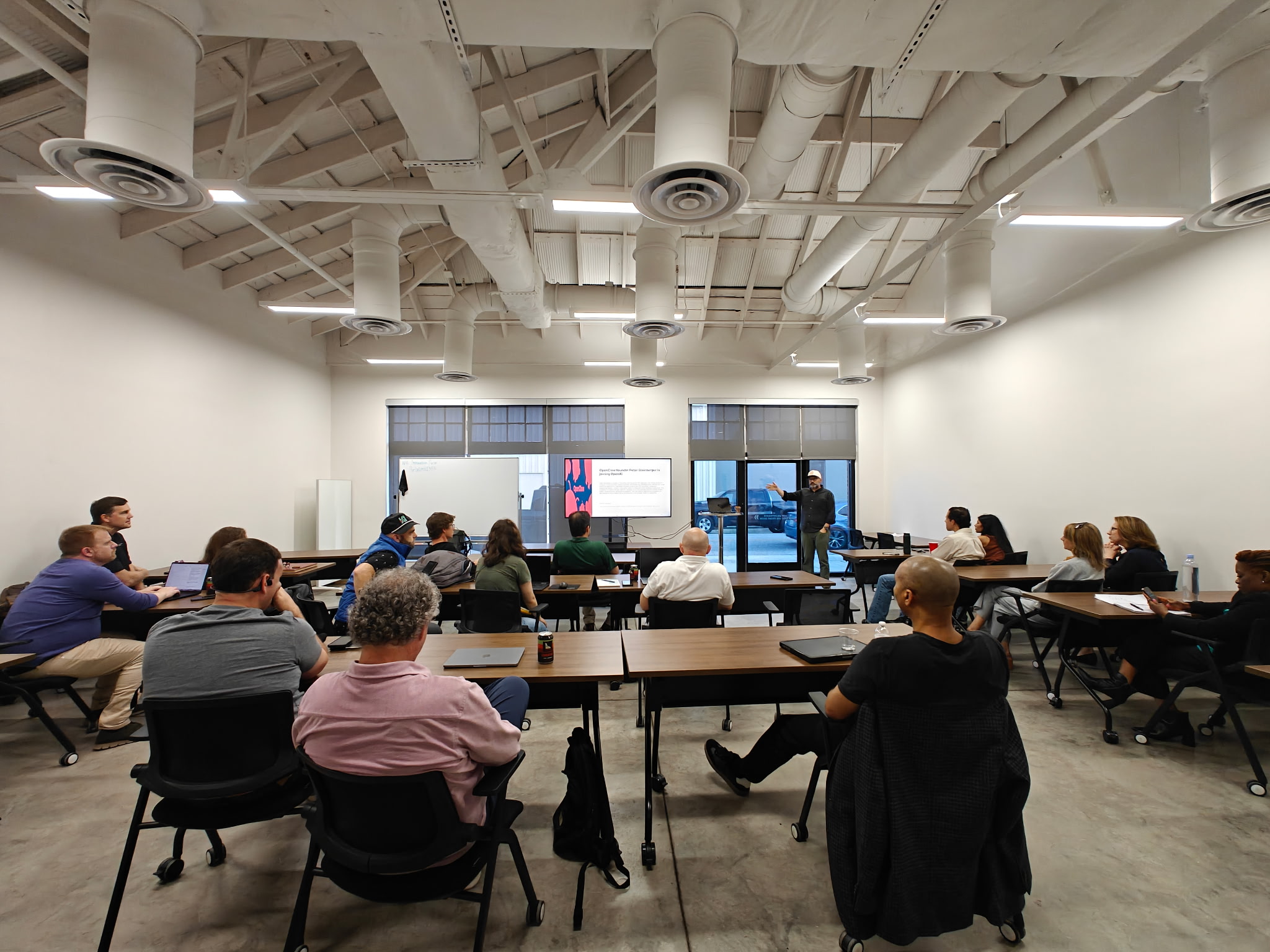
A buzzing room at last week's LA-AI Mobile Meetup.

A buzzing room at last week's LA-AI Mobile Meetup.

Know someone who would enjoy this newsletter?

Forward this email or share the link below

https://la-ai.io/newsletter/view/2026-03-05
Subscribe to LA-AI Newsletter

Join Our AI Community

Get weekly insights on AI innovations and exclusive updates on LA-AI events

Subscribe Now